1. Opening: Executive Summary + Value Proposition
In the world of thermoplastic road marking paints, selecting the right material means striking the optimal balance between durability, visibility, and site-specific fit. Thermoplastic road marking paint is a solid coating that must be heated to a high temperature to become molten before application. It hardens rapidly upon cooling, forming a strong bond with the road surface. It can withstand the intense pressure of daily vehicle traffic, UV radiation, and harsh weather conditions such as rain, snow, and wind. With a significantly longer service life and superior wear resistance compared to ordinary cold-spray paints, it stands out as a reliable choice for road marking projects.
At a Glance: Core Advantages of Thermoplastic Markings
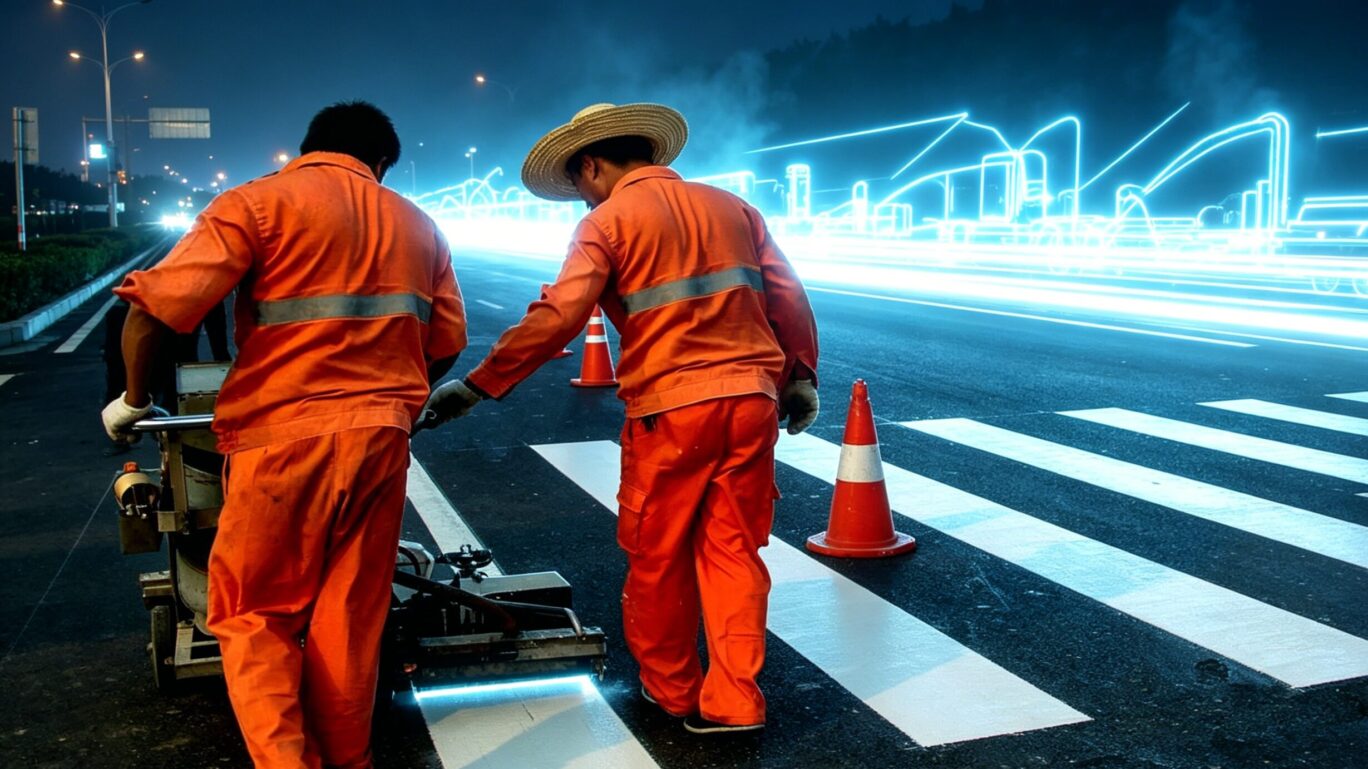
This material excels in long-lasting performance, bright color retention, and adaptability to high-traffic roads and complex traffic scenarios. Unlike traditional coatings, thermoplastic markings maintain clear white and yellow lines for extended periods. When embedded with reflective glass beads, they enhance visibility in low-light environments at night, thereby boosting road safety.
30-Second Quick Reference Chart: Core Differences – Thermoplastic vs. Cold Spray vs. MMA
| Material Type | Service Life | Cost | Applicable Scenarios |
| Thermoplastic | Long (usually 3–5 years or more) | Medium-high | Highways and busy urban roads |
| Cold Spray Paint | Short | Low | Low-traffic sections |
| MMA (Methacrylic) | Medium-long | High | Airports or special industrial scenarios |
2. Part 1: What Is Thermoplastic Paint? – Detailed Explanation of Core Working Principles
Definition of Thermoplastic Road Marking Paint
Thermoplastic road marking paint is a highly durable, thermoplastic coating typically available as a solid powder. During construction, it is heated to over 200°C to melt into a liquid state, then applied to the road surface. Upon cooling, it forms a sturdy, long-lasting marking layer. Unlike ordinary coatings, thermoplastic paints do not cure at low temperatures; instead, they rely on a physical process—heating, melting, and cooling to solidify.
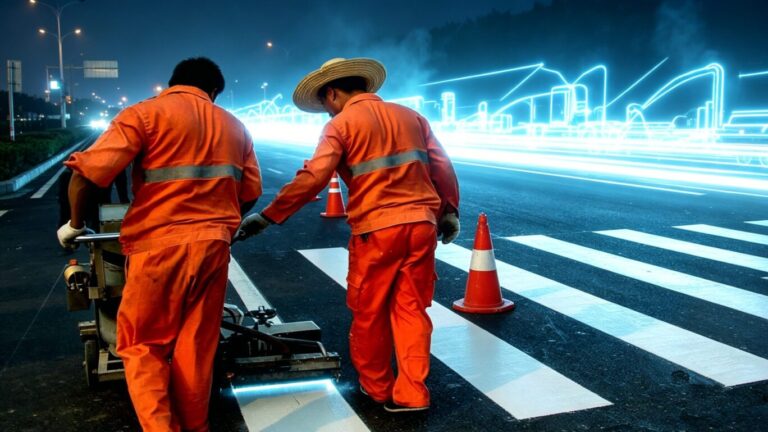
Construction Process of Thermoplastic Paint
- Heating: Heat the powder coating to 200°C until it melts into a liquid state.
- Application: Brush the molten coating onto the road surface to form a thick layer.
- Cooling and Curing: The coating solidifies rapidly upon cooling, bonding tightly with the road surface to create a wear-resistant and durable marking.
The thick marking formed by this coating process offers superior wear resistance, capable of withstanding high-intensity vehicle rolling and weather changes, while providing long-term visual guidance.
Core Advantages of Thermoplastic Paint
- Exceptional Durability: The biggest strength of thermoplastic road marking paint is its ultra-high durability. On high-traffic roads, it can serve for 3–5 years or even longer.
- High Visibility: The incorporation of glass beads in the coating allows markings to reflect light at night or in rainy conditions, significantly improving visibility in low-light environments.
- Superior Wear Resistance: The cured coating of thermoplastic paint is thicker and more robust than traditional cold-spray coatings, resistant to peeling, and able to maintain clear markings for extended periods.
Why Choose Thermoplastic Paint?
Compared to ordinary coatings, thermoplastic paint offers stronger durability and better UV resistance, making it suitable for various road surface conditions. The tough film formed through high-temperature construction effectively resists UV radiation, rain, road wear, and traffic load. It is particularly ideal for marking highways and high-traffic urban roads.
Additionally, the physical curing process used in thermoplastic construction makes it insensitive to ambient temperature changes. Construction can be completed quickly, reducing construction cycles.
Industry Data Support
According to industry standards, thermoplastic road marking paint typically has a service life of 3–5 years and is suitable for various climatic conditions, performing especially well in cold and humid regions. Compared to traditional cold-spray paints, thermoplastic paint has obvious advantages in durability, wear resistance, and color rendering.
Summary
Thermoplastic road marking paint is a high-durability, high-visibility coating system. The thick, sturdy markings formed after construction can withstand high traffic loads and harsh weather conditions. As an efficient and long-lasting road marking solution, it is more suitable for road marking projects requiring high durability than traditional cold-spray paints.
3. Part 2: 5 Core Decision-Making Matrix for Selection – The Core Competitiveness of the Article
Instead of a simple introduction, what truly helps users make decisions is an operable and quantifiable selection framework. This section distills the key factors influencing thermoplastic paint performance into five core dimensions. Each dimension includes clear recommendation logic and matching solutions, enabling users to quickly find the most suitable formula for their specific scenarios.
Core Structure Explanation
For each factor, we create a separate section, presented in the form of comparison tables or scorecards, allowing readers to “understand at a glance.”
Factor 1: Traffic Volume and Wear Level
Road usage determines the wear resistance requirements of the coating:
| Road Type | Typical Traffic Flow | Recommended Type |
| Ultra-Low Traffic | Residential areas, parking lots | Standard Type |
| Medium Traffic | Urban branch roads | Wear-Resistant Type |
| High Traffic | Main roads, highways | High-Durability Type |
| Heavy-Duty Traffic | Industrial zones, freight corridors | Anti-Pollution Heavy-Duty Type |
Explanation: The more vehicles there are, the greater the road wear, requiring more wear-resistant and durable thermoplastic coatings. This classification helps clarify the direction of selection.
Factor 2: Climatic and Environmental Challenges
Different climates impact the service life and visibility of markings:
- Hot and Humid Regions (High Temperature and Rainfall): Prone to skidding and discoloration → Recommended weather-resistant thermoplastic road markings
- Cold Regions (Frost Resistance and Crack Resistance): Repeated freeze-thaw cycles cause marking cracking → Requires crack-resistant thermoplastic formulas
- High UV Radiation Regions (Anti-Powdering): Markings are prone to fading → Recommended UV-resistant thermoplastic powder
Explanation: Climate significantly affects material aging, adhesion, and marking lifespan and cannot be ignored in selection.
Factor 3: Road Base and Adhesion
Different road surface materials greatly impact the adhesion of thermoplastic road markings:
- Asphalt Pavement: Numerous surface micropores ensure good adhesion → Standard construction process
- Concrete Pavement: Smooth surface → Must use special primer to improve adhesion
- Damaged Pavement: Repair first before construction or use enhanced primer
Concise Tip: Especially on concrete pavements, it is essential to use a compatible primer; otherwise, the thermoplastic marking is prone to edge warping and peeling.
Factor 4: Construction Method and Final Marking Effect
The construction method of thermoplastic markings also influences the final outcome:
- Spray Method: Suitable for straight and flat markings, fast construction speed
- Extrusion Method: Suitable for high-durability thick-coating markings
- Scraping Method: Suitable for complex graphic markings or prefabricated formwork
Recommended Combinations
- Spray + Reflective Glass Beads = Excellent night visibility
- Extrusion + High-Thickness Thermoplastic = Optimal durability
Explanation: Reasonable selection of construction methods can significantly improve construction results, rather than just focusing on the coating itself.
Factor 5: Performance Priority (Visibility vs. Durability vs. Fast Curing)
Different users have varying performance priorities. We propose a performance triangle model:
- High Visibility + Fast Curing: Suitable for urban streets prioritizing night visibility
- Durability First: Suitable for highways and high-wear sections
- Fast Curing + Durability: Suitable for sections with small construction windows and minimal traffic disruption
This model helps users combine their priorities to select the optimal formula, for example:
- Choose “high visibility + fast drying” = Visibility-Priority Thermoplastic Paint
- Choose “durability + fast curing” = Long-Life Construction Combination
Summary: Why Is This Decision Matrix the Most Practical?
These 5 factors cover most core needs in thermoplastic road marking construction decisions—traffic flow, climate and environment, road surface type, construction methods, and performance priorities. These are exactly the key concerns of users when purchasing coatings. By quantifying factors, clarifying grades, and providing recommended solutions, users can make clear decisions from ambiguous choices.
4. Part 3: Ultimate Comparison – Thermoplastic Paint vs. All Alternatives
When choosing road marking materials, most people only focus on a single product while ignoring the huge differences in cost, durability, construction speed, and visibility between different coating types. This section provides a comprehensive comparison of thermoplastic road markings with major alternative materials in the industry, helping you make a wise decision from the perspective of actual use effects and total costs.
Core Strategy
We compare several common road marking materials in the industry across the same dimensions, analyzing them one by one:
- Initial Cost (One-Time Construction Cost)
- Life Cycle Cost (5-Year TCO: Total Cost of Ownership)
- Construction Speed and Traffic Opening Time
- Durability (Months/Years)
- Night Visibility
- Environmental Friendliness
- Applicable Scenarios
Comparison Objects
| Material Type | Brief Description |
| Thermoplastic | Molten and cured at high temperature, thick coating with wear resistance and good reflectivity (optional) |
| Cold-Spray Water-Based Paint | Simple construction, low cost, weak durability |
| Cold-Spray Solvent-Based Paint | Good relative brightness, moderate wear resistance |
| MMA (Two-Component) | Fast curing, good low-temperature resistance, high cost |
| Epoxy Coating | Strong adhesion, chemical corrosion resistance, usually used for special scenarios |
| Preformed Tape | No heating required, fast construction, good initial visual effect |
8-Dimension Comparison Table (Simplified Version)
Note: Data are summarized based on industry experience and can be refined or supplemented with actual values for specific projects if needed.
| Comparison Indicator | Thermoplastic | Cold-Spray Water-Based Paint | Cold-Spray Solvent-Based Paint | MMA | Epoxy Paint | Preformed Tape |
| Initial Cost | Medium-High | Lowest | Low | High | Medium-High | High |
| 5-Year Life Cycle Cost | Lowest | High | High | Medium | Medium | Highest |
| Construction Speed | Medium | Fastest | Fast | Fast | Slow | Fastest |
| Traffic Opening Time | Medium | Fastest | Fast | Fast | Slow | Fastest |
| Durability (Months) | Longest | Short | Short-Medium | Medium-Long | Medium-Long | Short |
| Night Visibility | Good (with glass beads) | Poor | Average | Good | Average | Excellent |
| Environmental Friendliness | Medium | High | Medium | Medium | Medium | High |
| Applicable Scenarios | High-Traffic Main Roads | Low-Traffic Sections | Municipal Roads | Variable Temperature Zones | Special Sections | Temporary or Light-Load Sections |
Conclusion Analysis
Thermoplastic Markings Offer the Best Performance in Most Long-Term Scenarios
Although the initial cost of thermoplastic markings is slightly higher than that of cold-spray paints, their far superior durability reduces the need for frequent reapplication. The total 5-year cost (TCO) is significantly lower.
Thermoplastic paint performs exceptionally well on highways, urban main roads, and other high-traffic sections. The thick film formed by it is more wear-resistant and less prone to peeling than “thin-film paints”.
Reflective glass beads can be added as needed to enhance reflective performance at night and in rainy conditions, improving road safety.
Cold-Spray Paints Are Suitable for Budget-Constrained or Short-Term Projects
They offer fast initial construction and low cost but have short durability, requiring annual repainting. Along with traffic control costs, the overall expense is high.
MMA and Epoxy Are More Suitable for Special Environments
Two-component MMA is ideal for extreme climates or scenarios requiring fast traffic opening, but its high cost makes the total cost lack universal advantage.
Epoxy is more suitable for static facilities, special road surfaces, or corrosive environments and is not the main alternative for large-scale road marking.
Preformed Tapes Offer Fast Construction and Good Visual Effects but Short Service Life
Suitable for temporary marking, construction guidance, or short-term projects.
Practical Tips for Users
Prioritize Thermoplastic Markings When:
- Requiring long-term durability
- Working on main roads, highways, and high-wear environments
- Having high requirements for night visibility
Suitable for Cold-Spray Paints When:
Low-traffic sections
Extremely limited budgets
Temporary marking needs
Suitable for MMA/Epoxy When:
Extreme climatic conditions
Requiring fast curing or chemical corrosion resistance
5. Part 4: In-Depth Cost-Benefit Analysis – Calculate Your True ROI
When choosing road marking materials, cost is not a static number but a “true calculation” over time. At first glance, some materials may seem cheap, but they may imply high costs for frequent maintenance later; while seemingly expensive materials may be more cost-effective in the long run. This section uses a real case simulation to break down these costs, building trust and authority.
Scenario Assumption: Marking Project for a 1-Kilometer Two-Way Two-Lane Road
We assume a common municipal marking project:
- Road Length: 1 kilometer
- Motorway Lanes: Two-way two lanes
- Marking Requirements: Center line, edge lines, guide arrows, and other conventional markings
This is the most common road marking scenario in cities, easy to understand and reference.
Scheme Comparison: Cold-Spray Paint vs. Thermoplastic Markings
We compare two typical schemes:
| Project Item | Scheme A: Cold-Spray Water-Based Paint | Scheme B: High-Quality Thermoplastic Markings |
| Initial Material Cost | Low | Medium-High |
| Construction Speed | Fast | Medium |
| Traffic Opening Time | Short | Medium |
| Service Life | Short (about 6–12 months) | Long (about 3–5 years or longer) |
| Maintenance Frequency | Repainting annually | Repainting once every 3 years |
| Material Wear Resistance | Weak | Strong |
| Reflective Performance | Average | Better (optional) |
📈 5-Year Total Cost Calculation (TCO)
We divide costs into three categories:
- Material Costs (Paint / Thermoplastic)
- Construction Costs (Labor + Equipment + Traffic Control)
- Maintenance Costs (Indirect costs from repeated construction)
Scheme A: Cold-Spray Paint
- Initial construction: Low cost
- Repainting in the second year: Additional cost incurred
- Repainting in the third and fourth years: Same as above
- Repainting required about 5 times within 5 years
Due to the weak durability of cold-spray markings, maintenance costs are high.
Scheme B: Thermoplastic Markings
- Initial construction: Slightly higher cost
- Service life: 3–5 years
- Only 1 repainting required within 5 years
Despite the higher initial investment, thermoplastic markings require fewer maintenance operations, resulting in a low total cumulative cost.
Intuitive Conclusion: Thermoplastic Markings Are More Cost-Effective (Long-Term)
We use a bar chart for illustration (can be used as an illustration):
plaintext
5-Year TCO of Cold-Spray Paint
|■■■■■■■■■■■■■■■■■■| High
5-Year TCO of Thermoplastic Markings
|■■■■■■■■■■■| Significantly Lower
Written Conclusion:
Although the initial cost of thermoplastic markings is higher, their 5-year total cost of ownership (TCO) is far lower than that of cold-spray paints. This is because cold-spray paints require repeated construction, as well as repeated traffic control and labor costs, while thermoplastic markings can last for many years.
Why Is This the “True ROI”?
- Ignoring short-term costs and only focusing on initial expenditure will lead to misleading decisions
- Longer service life and fewer maintenance mean lower long-term expenses
- What managers truly care about is: How much money do I save in 5 or 10 years?
This is why many road marking experts recommend:
“When evaluating value, do not focus solely on the initial purchase price, but on the lowest life cycle cost.”
One-Sentence Summary for Users
Want to save money? Do not choose the cheapest option, but the one with the lowest life cycle cost.
In most conventional road scenarios, the total cost (materials + construction + maintenance) of thermoplastic markings over a 3–5 year period is often lower than that of cold-spray paints, making them a more cost-effective long-term choice.
6. Part 5: Supplier Evaluation Checklist – From “What to Buy” to “Whom to Buy From”
After determining which thermoplastic road marking paint to purchase, what truly determines the success of the project is selecting a reliable partner from numerous suppliers. Many users only focus on price but ignore the evaluation of supplier strength, technical support, and product reliability, which often leads to ongoing construction issues, unstable materials, or after-sales troubles.
This section presents a practical supplier evaluation checklist to help you upgrade from “what coating to buy” to “which coating supplier to choose”.
1. Complete Technical Documentation
A professional supplier should provide full technical documentation, which not only backs up product quality but also serves as a reference for on-site construction.
Required documents include:
- TDS (Technical Data Sheet): product composition, application instructions, performance specifications, etc.
- MSDS (Material Safety Data Sheet): safety information, hazard warnings, and risk control measures
If a supplier cannot provide these documents promptly, their quality system is likely unregulated—proceed with caution.
2. Project References and Verification
The best proof of quality is real-world performance.
Ask the supplier for successful projects similar to yours, including:
- On-site construction photos
- Client feedback records
- Actual performance data during installation
- Maintenance cycles and long-term field performance
Genuine references demonstrate that the supplier has mature application experience and reliable material quality, which is more trustworthy than marketing claims alone.
3. Sample and Testing Support
Top suppliers do not rely on verbal promises. They will support small‑scale trials or sample testing.
You may request:
- Free or low-cost samples for test application
- Simple on-site testing methods for reflectivity, adhesion, etc.
- Third-party test reports or access to independent testing
This support allows you to verify whether the material truly meets project requirements before full deployment.
4. Technical Support and After-Sales Service
Road marking materials are not “buy-and-forget” products. Site conditions often bring unexpected challenges:
- Unfavorable pavement temperature
- Uneven or contaminated base layers
- Uneven glass bead distribution
- Approaching rain or unfavorable weather
A quality supplier should provide:
- On-site technical guidance or construction supervision
- Remote support (phone, video, written instructions)
- Post-construction quality follow-up and issue resolution
A supplier’s technical and service capabilities often determine how smoothly the project runs and how quickly problems are resolved.
Conclusion
Choosing a supplier is not about finding the cheapest one—it is about professional capability, service responsiveness, and trustworthy partnership. A strong supplier not only delivers reliable materials but also solves problems during construction and long-term maintenance.
With this checklist, you can evaluate suppliers systematically and make a professional purchasing decision.
7. Frequently Asked Questions (FAQ)
1. How much thermoplastic paint is used per square meter?
Under standard thickness (1.5–2.5 mm), consumption is approximately 3–5 kg/m². Thicker markings require more material.
2. What equipment is needed for thermoplastic road marking?
Common equipment includes a thermoplastic preheater, marking machine, primer sprayer, and glass bead dispenser.
3. Can application be done in rainy or low-temperature conditions?
Not recommended. Rain or damp pavement reduces adhesion. Performance drops significantly when temperature is below 5°C.
4. How soon can traffic reopen after thermoplastic marking?
Generally 3–5 minutes of cooling is sufficient for traffic to resume—one reason it is more efficient than cold paint.
5. How to improve the reflectivity of markings?
The key is high-quality glass beads, controlled application rate and embedment depth, and proper construction temperature.
6. How long does thermoplastic marking last?
Under normal conditions: 1–2 years on urban roads, over 2 years on highways, depending on traffic volume.
7. What pavements are suitable for thermoplastic markings?
Suitable for asphalt and concrete. A primer is strongly recommended on concrete to improve adhesion.
8. Do thermoplastic markings peel easily?
If applied correctly (proper temperature, clean surface, primer used where needed), they do not peel easily.
9. What causes cracking or lifting of markings?
Typically insufficient heating, poor surface cleaning, or unstable material quality.
10. Are glass beads mandatory?
Yes. Glass beads directly determine night-time reflectivity and are critical to road safety performance.
11. How thick can thermoplastic markings be?
Standard: 1.5–2.5 mm. Raised profile or rumble strips can reach 3–5 mm or more.
12. What is the ideal application temperature?
Generally 180–220°C, adjusted according to the product’s technical data sheet.
13. Does thermoplastic paint have environmental issues?
High-quality thermoplastic is solvent-free and low-pollution, making it more eco-friendly than traditional paints.
14. Can marking colors be customized?
Yes. White and yellow are standard; other colors can be formulated as required.
15. How to extend the service life of markings?
Use high-quality materials, control application temperature, ensure clean pavement, and apply glass beads properly.
16. What material is used for raised profile markings (rumble strips)?
Typically high-thickness thermoplastic with specialized marking equipment.
17. What are the storage requirements for thermoplastic paint?
Store in a dry, ventilated area, away from moisture and direct high-temperature exposure.
18. What is the difference between thermoplastic and cold paint markings?
Thermoplastic is more wear-resistant, longer-lasting, and opens to traffic faster, but requires higher equipment investment.
8. Conclusion & Multi-Level Calls to Action (CTA)
Core Conclusion
When selecting thermoplastic road marking paint, you do not need the most expensive or fully featured option from the start. A more efficient approach is to first clarify your project priorities—such as wear resistance, reflectivity, construction speed, or budget constraints—and then focus on 2–3 key indicators to quickly identify the best product type.
Simply put: choosing the right direction matters more than choosing the most parameters.
CTA 1 (Low-Threshold): Get Your Selection Tool
Download the Thermoplastic Road Marking Paint Selection Checklist + ROI Cost Calculator to quickly determine:
- Actual material consumption for different thicknesses
- Recommended solutions for different road scenarios
- Approximate overall project cost range
Ideal for users comparing options and preparing budgets.
CTA 2 (High-Value): Get Professional Advice
Contact our professional road marking team for free one-on-one project recommendations, including:
Ways to extend marking life within budgetis for subsequent construction.
Material recommendations tailored to your project
Optimized construction plans
Required technical documents include:
- TDS (Technical Data Sheet): Specifies product composition, usage instructions, performance indicators, etc.
- **MSDS (Material Safety Data Sheet)